
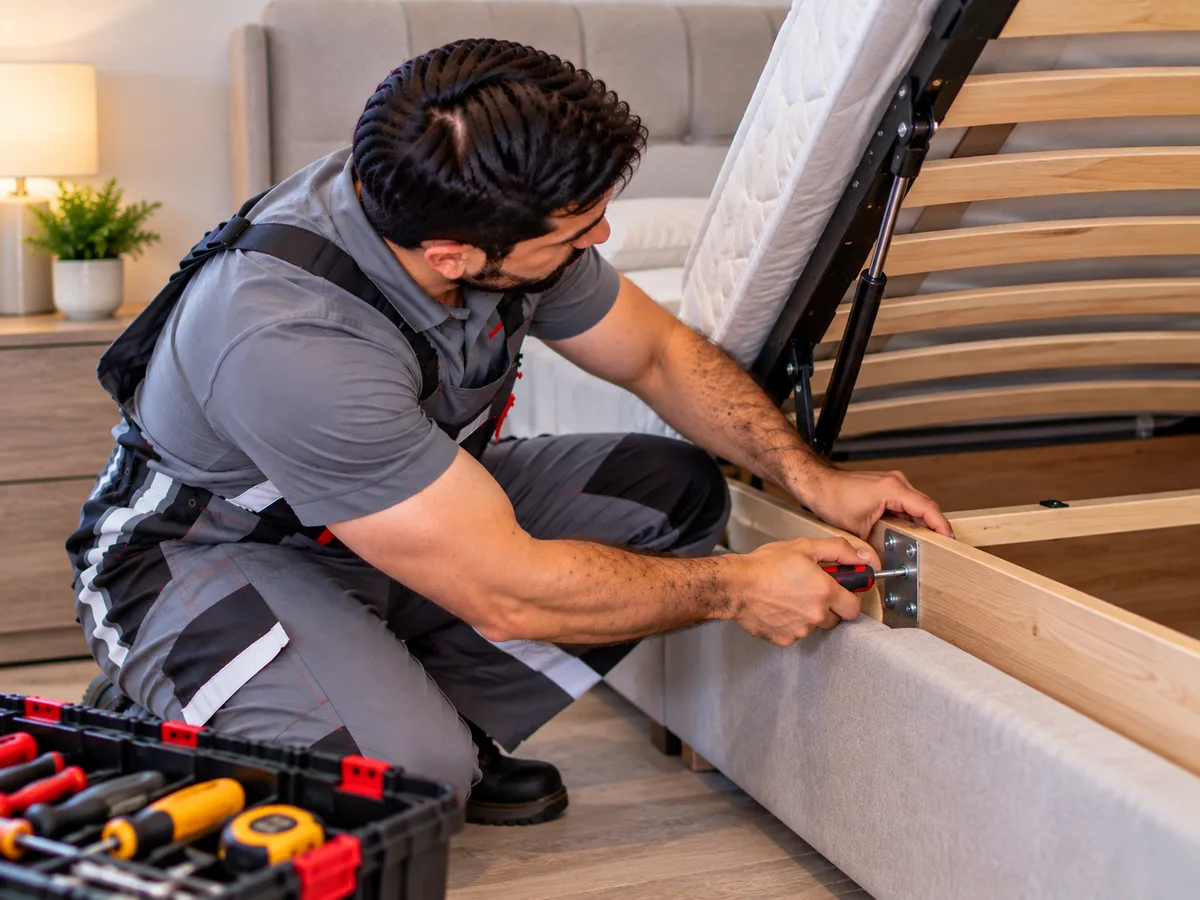
If the bed wobbles, has loose joints, or makes squeaking noises during use, one of the most common causes may be loose connections in the frame. If the problem is not repaired in time, the looseness may increase and cause damage to other parts of the structure.
A bed frame usually consists of side rails, a headboard, a footboard, center supports, and fasteners that connect these components. Looseness in any of these parts can affect the stability of the entire structure.
One of the most common causes is loose screws and bolts. Because the bed is continuously subjected to weight and movement, fasteners may gradually lose their original tightness.
During repair, all connection points of the frame should first be inspected. Loose bolts and screws can be tightened with the appropriate tools. However, fasteners should not be overtightened, as this may cause cracks or deformation in wood or particle board.
Sometimes the problem is not limited to a loose screw. If the screw hole has become enlarged, the screw may no longer hold securely in the material. In this situation, simply tightening the screw further may not provide a long-term solution.
Depending on the extent of the damage, a furniture repair technician can restore the connection point, use an appropriate fastener, or reinforce the structure with additional components.
Metal brackets and connecting hardware can also become loose, bent, or damaged over time. If the strength of the frame depends on these components, their condition should be inspected separately.
Looseness where the side rail connects to the headboard or footboard is another common problem. When this happens, the frame may wobble and make unwanted noises whenever the bed moves.
If the bed frame has a cracked wooden component, simply tightening the screws may not be enough. Depending on the size and location of the crack, the damaged wooden part may need to be repaired, reinforced, or replaced.
Beds made from particle board or MDF may also develop damaged or enlarged fastening holes. Using screws of the wrong size or repeatedly disassembling and reassembling the same connection can weaken the joint.
The center support section of the bed should also be inspected. In double and larger beds, the center beam and support legs play an important role in distributing weight properly.
If the center support leg is loose, bent, or does not sit properly on the floor, movement or sagging may occur in the middle of the frame. Over time, this can also place additional stress on the side sections of the bed.
The bed slats and their supports can also be a source of noise and instability. If the slats have moved out of position, are broken, or their supports have become loose, the bed may squeak and feel unstable during use.
Sometimes the frame may seem loose even though the actual noise comes from the headboard touching the wall, uneven contact between the legs and the floor, or movement of the bed slats. Therefore, the exact source of the problem should be identified before starting the repair.
The bed legs also affect the stability of the structure. A loose or bent leg can cause the bed to wobble and place additional stress on the frame connections.
If the floor is uneven, even a structurally sound bed frame may move. For this reason, both the frame itself and the way all the legs sit on the floor should be checked during diagnosis.
A squeaking bed does not always indicate serious frame damage. The noise may come from wooden parts rubbing against each other, metal connections, loose fasteners, or moving slats.
To identify the source of the noise, controlled pressure can be applied to different parts of the bed to determine which connection point is moving.
If a loose bed frame continues to be used for a long time, a small amount of movement can gradually increase, fastening holes may become damaged, and cracks may develop in wooden components. Therefore, it is better to repair the problem at an early stage.
When repairing a bed, screws that are too long or unsuitable for the structure should not be used. A screw may come through the other side, damage upholstery material, or weaken the frame structure.
A professional furniture repair technician can inspect the bed frame and identify loose joints, damaged fasteners, cracked wooden components, problems with the center support, legs, and bed slats.
Depending on the condition of the structure, repairs may include tightening screws and bolts, restoring damaged fastening holes, reinforcing the frame with additional metal brackets, repairing support components, or replacing damaged parts.
A properly repaired bed frame becomes more stable, unwanted movement and noise are reduced, and weight is distributed more evenly throughout the structure.