
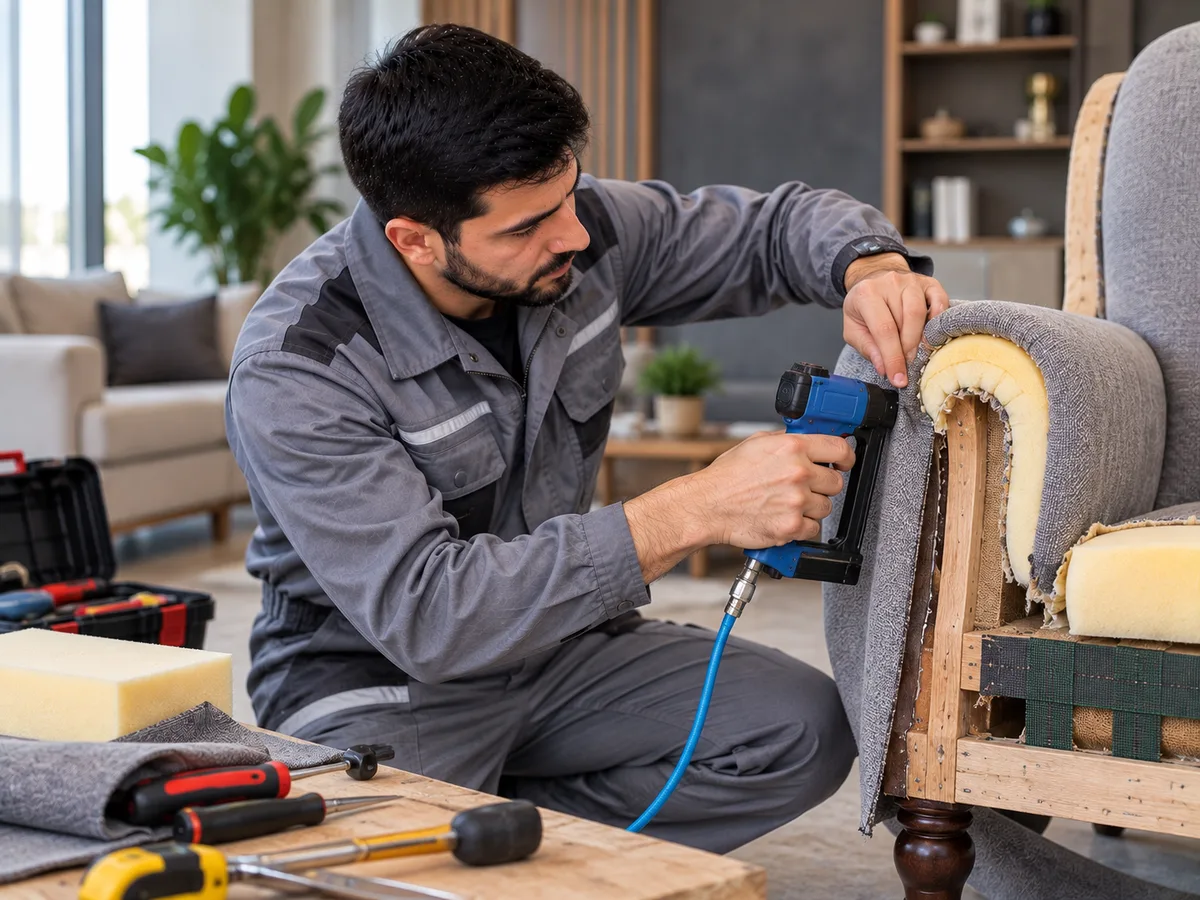
After long-term use, armchairs may develop problems such as worn upholstery, sagging foam, seat deformation, and loose frame components. In such cases, instead of replacing the entire armchair, it may be possible to repair and restore it depending on its overall condition.
Before starting the repair, the general condition of the furniture should be inspected. The upholstery, foam, frame, springs, legs, joints, and other components are checked to determine which parts need to be replaced and which can be restored.
Worn upholstery is one of the most common problems with armchairs. If the fabric is torn, faded, permanently stained, or heavily worn, replacing the upholstery material can significantly improve the appearance of the armchair.
When choosing new upholstery, attention should be paid not only to the color and design but also to whether the material is suitable for the expected level of use. Fabric, artificial leather, and other upholstery materials can be selected according to the room where the armchair will be used and the desired appearance.
If the seat has lost its original comfort and sinks excessively when someone sits on it, the problem may be related to the foam. With prolonged use, foam gradually loses its shape and elasticity, reducing seating comfort.
When replacing the foam, the correct thickness and density should be selected according to the dimensions and construction of the armchair. Incorrectly selected foam can make the seat too soft or excessively firm and may also cause it to deform again within a short period.
In some armchairs, comfort depends not only on the foam but also on the condition of the spring system. Loose, broken, or displaced springs can cause one side of the seat to sag and make the armchair uncomfortable to use.
If the armchair wobbles, makes creaking noises when used, or some of its components have become loose, this may indicate a problem with the frame. In wooden frames, joints and fasteners may loosen, while individual components can crack.
During frame restoration, loose joints are reinforced, damaged components are repaired, and individual parts are replaced when necessary. Replacing only the upholstery and foam without properly repairing the frame may not solve the main problem.
The legs of the armchair are also an important part of its overall structure. If the legs are loose, cracked, or deformed, the stability of the armchair may be affected. If these problems are not repaired in time, additional stress may be placed on other parts of the frame.
Once the old upholstery has been removed, the internal components of the armchair can be inspected more thoroughly. At this stage, the foam, frame, springs, and joints are checked to determine whether additional repair work is required.
When replacing the upholstery, it is important to stretch the material correctly and secure it according to the shape of the armchair. Upholstery that is too loose or unevenly fitted may wrinkle quickly and negatively affect the appearance of the furniture.
Whether an armchair is suitable for repair depends on the condition of its frame, its construction, and the extent of the damage. If the armchair has a strong and high-quality frame, replacing the upholstery and foam can significantly extend the useful life of the furniture.
Before starting the repair, it is recommended to determine which parts need to be replaced, what type of upholstery and foam will be used, what frame repairs are required, and the approximate cost. This helps to plan additional work and expenses more accurately.
If there are problems with the upholstery, foam, frame, springs, or other parts of the armchair, it is recommended to contact a professional furniture repair technician. The technician can inspect the condition of the armchair and determine how the upholstery should be replaced, the foam renewed, the frame reinforced, and other restoration work carried out.